


Key takeaways
A Meta ads account has three levels: the campaign level, the ad group (also called ad set) level and the ad level.
The heavy lifting, in terms of performance optimization, happens on the ad group level. This is where advertisers define their individual performance goal, for example, maximizing the number of qualified leads.
B2B SaaS advertisers should consolidate their campaigns - one campaign per objective that uses campaign budget optimization. For example, if you want to optimize for leads, run all of your ads inside a single campaign.
Furthermore, a campaign should contain a single winning ad group that includes the best performing ads, alongside several testing ad groups.
The goal of this Meta ads campaign structure is to find tests that beat the existing winning ads. A testing ad group beats the winning ad group if it receives at least 50% of the total campaign budget and undercuts the campaign’s average cost per lead.
New winning ads are added to the winning ad group in order to scale the campaign. It’s important to keep the original testing ad group active as long as it produces good results - having the same ad live twice is not a problem. The testing ad group should only be turned off if the same ad starts producing results in the winning ad group and stops producing results in the testing ad group.
Hey 👋🏼 I’m Fabian, great to have you here. In my newsletter “Get Hooked! Marketing”, I share proven tactics from the trenches of B2B SaaS advertising every week. Built to make you a top 5% marketer.
Copy the exact formula I use to repeatedly build simple static ads that generate six-figure B2B SaaS revenue. Backed by more than 6,000 hours of creative testing and $5M+ in total revenue generated on Facebook and Instagram.
The lessons I’m sharing here are the mental guardrails for successful Meta advertising.
Each article includes a Resource Prompt that you can use in your favorite AI chat tool. It will give you extra resources to help you implement the learnings in your own ad account.
📚 Reading Tip: Getting tracking right is the highest-leverage thing you can do before launching your first campaign. My step-by-step guide to Meta ads tracking covers the Pixel, CAPI and CRM integration.
📚 Reading Tip: Campaign objectives and performance goals can make or break your advertising success. My guide to Meta ads objectives and goals walks you through every option and how to pick the right one.
Table of contents
Meta ads campaign structure explained
The Golden Rule: One campaign per campaign objective
Example of a Meta ads campaign structure for B2B SaaS
Frequently asked questions and answers
Resource prompt
Meta ads campaign structure explained
Inside your Meta ad account, you’ll find campaigns, ad groups and ads. Every ad network follows this hierarchy. A campaign can have several ad groups and each ad group can contain many ads.
On the campaign level, you define the broader campaign objective. This includes:
Creating Awareness
Increasing Traffic
Increasing Engagement
Generating Leads
Promoting Apps
Generating Sales
On the ad group level, you define your target audience and a more specific performance goal. The options for the performance goal are determined by the selected campaign objective.
Here’s an example:
Let’s say you choose Leads as your campaign objective. With the performance goal, you specify which type of leads you want to optimize for. A B2B business might choose marketing-qualified leads or sales-qualified leads as their conversion event.
On the ad level, you create your image or video creatives. This includes ad headlines, descriptions and the landing page.
Once you understand this hierarchy, structuring campaigns becomes much easier.
The Golden Rule: One campaign per campaign objective
This is your key takeaway when designing a Meta ads campaign structure. I repeat:
📝 Note: One campaign per campaign objective.
Let’s break it down by sticking to the B2B example from earlier.
You decide to run Meta ads for lead generation. You market a SaaS product with several different features. You might think it’s a good idea to run separate campaigns for each feature or use case.
But it’s not. Because campaign learning becomes siloed.
More conversions lead to faster campaign learning. And the faster Meta learns who to target, the faster you see better results. It’s as simple as that.
📝 Note: The learning phase is the period after launch during which Meta's algorithm gathers performance data and delivery fluctuates. It ends when your ad group hits 50 conversions within 7 days, after which delivery stabilizes.
Better results don’t just mean more conversions. They also mean more cost-efficient conversions. The faster your campaign learns, the quicker your cost per result will drop.
But when you split the same campaign objective across multiple campaigns, you slow down the learning process.
Because you’re also splitting your ads. You are giving Meta fewer options to target your audience per campaign.
For the same reasons outlined here, I also recommend sticking to one performance goal per campaign.
Example of a Meta ads campaign structure for B2B SaaS
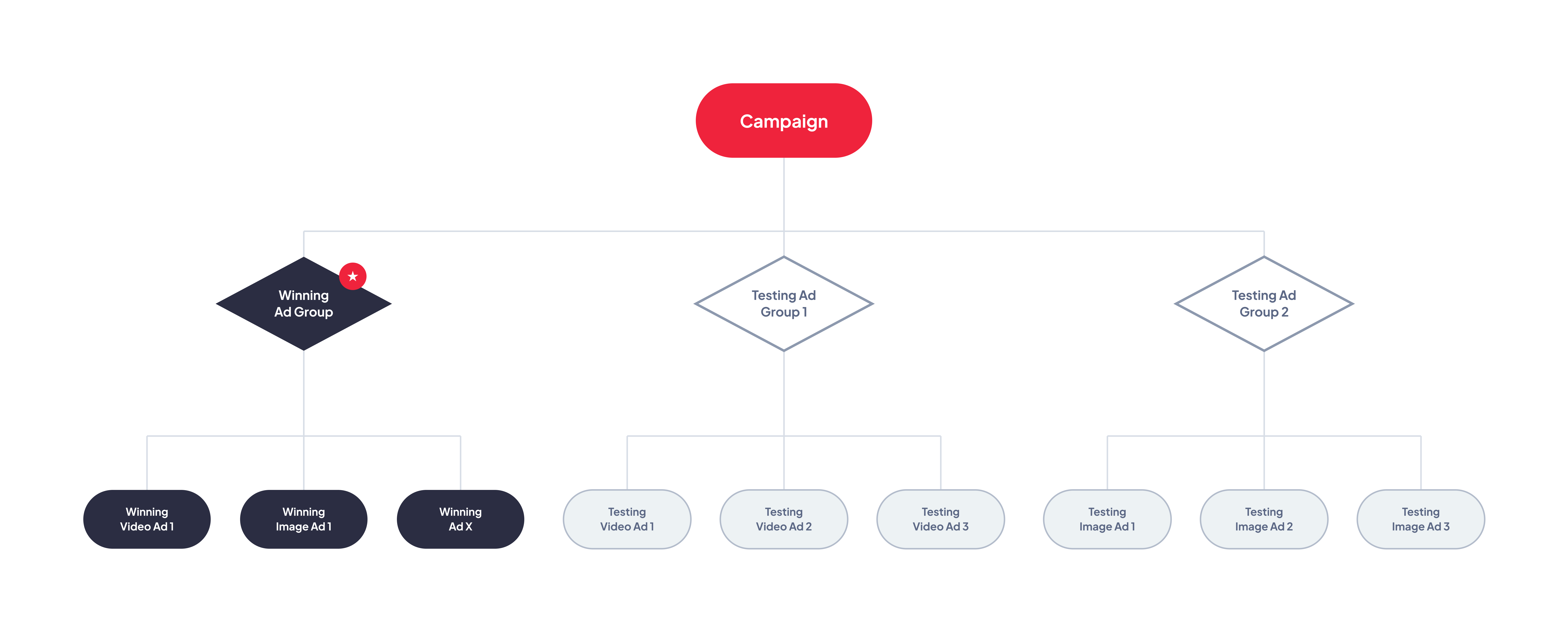
Our example follows the Golden Rule. We have one campaign per campaign objective.
I have used this structure for the last three years to turn $1M in ad spend into $5M+ in B2B SaaS revenue.
To make it work, you need to opt in for campaign budget optimization (CBO) in your campaign settings.
📝 Note: When you enable CBO, Meta automatically distributes your total campaign budget across ad groups to maximize overall performance. Instead of setting a fixed budget per ad group, Meta shifts spend toward the ad groups that are currently generating the best results.
There are two types of ad groups inside the campaign. One single winning ad group and several testing ad groups.
Each testing ad group tests a distinct creative angle.
The goal of this campaign structure is to identify new, successful ads to add to the winning ad group. Expanding the winning ad group allows the campaign to scale with larger budgets because the algorithm has more options to target your audience.
But how do you define success? A successful test is an ad group that receives the majority (I often look for 50% or more) of the total campaign budget. It also has to undercut the campaign’s average cost per result. In simple words: You want to find new ads that beat your existing winners.
This is one way to design a Meta ads campaign structure. You can choose a different one. But always follow this maxim:
📝 Note: The campaign structure should make it easy to test and scale your key performance driver: your ads.
Because today’s Meta ads perform best when you provide a high number of diverse creatives.
Another approach is also worth mentioning. It deviates a bit from the one campaign per campaign objective rule.
Instead of managing tests and winners in a single campaign, you create two campaigns. One contains only new tests and the other one contains only winning ads.
This can make campaign management easier. Especially when you work with a large number of creatives.
The principle stays the same. Scale by increasing the number of winning ads.
Frequently asked questions and answers
How many campaigns should I have in my Meta Ads account?
One per campaign objective. A campaign objective is the broader goal you set at the campaign level. Meta gives you six options: Awareness, Traffic, Engagement, Leads, App promotion and Sales.
If you run lead generation for a B2B SaaS product, you need one campaign. Every campaign you add beyond that fragments your conversion data and slows down algorithm learning.
What is campaign budget optimization and when should I enable it?
Campaign budget optimization (CBO) is a campaign-level setting that lets Meta distribute your total ad budget across ad groups automatically. Instead of assigning a fixed daily budget to each ad group, you set one total budget and Meta allocates it toward the ad groups generating the best results in real time.
Without CBO, all your ad groups receive a fixed budget share, regardless of how they perform. With CBO enabled, Meta shifts spend toward what is working, automatically.
How long does the Meta Ads learning phase last?
The learning phase is the period after launch during which Meta’s algorithm gathers performance data and delivery fluctuates. It ends when your ad group hits 50 conversions within 7 days, after which delivery stabilizes.
What is the difference between a test ad group and a winning ad group?
A well-structured Meta ads campaign contains two types of ad groups.
A test ad group runs one new creative angle. Its job is to compete against existing winners and prove whether it can generate conversions at a lower cost per result than the campaign average. Each test gets its own ad group so Meta can evaluate it fairly against the others.
A winning ad group contains only proven ads. These are ads that have already demonstrated they can capture the majority of campaign budget while beating the average cost per result. Once an ad meets those criteria, it moves into the winner pool to run at higher scale and budget.
How do I know when a test ad group is ready to join the winner pool?
Two conditions have to be true at the same time. The test ad group is capturing at least 50% of the total campaign budget. Its cost per result is also lower than the campaign average.
Budget share tells you Meta’s algorithm prefers this ad group over the alternatives. Beating the campaign cost per result tells you it is converting more efficiently. When both are met, move the winning ads from the test group into your permanent winner ad group.
Resource prompt
Copy this prompt into your favorite AI chat tool. You’ll receive hands-on tutorials and practical guides for designing an effective Meta ad account structure:
Role and objective

Act as a **Meta advertising strategist and performance marketing consultant**.

Your goal is to help me design an **effective Meta ad account structure for Facebook and Instagram campaigns**. The structure should make it easy for the Meta algorithm to **learn quickly, test new creatives and scale winning ads**.

Focus on **practical tutorials, frameworks and case studies** that explain how to structure campaigns, ad groups and ads for better performance.

Prioritize **recent resources (preferably from the last 2–3 years)** and **trusted sources** such as official Meta documentation, recognized performance marketers or well known analytics educators.

The goal is to build a **simple and scalable campaign structure that concentrates data, accelerates learning and enables efficient creative testing**.

---

### Step 1: Ask about my advertising setup

Before generating resources, ask me the following questions to understand my situation.

Ask them one by one or as a short list.

**Business model**

- B2B
- B2C
- Both

**Primary campaign objective**

- Leads
- Purchases
- App installs
- Traffic
- Other

**Average monthly ad budget**

- Less than $5k
- $5k–$50k
- $50k+

**Number of creatives available**

- Less than 5
- 5–20
- 20+

**Current campaign setup**

- Many small campaigns
- Few consolidated campaigns
- Not sure yet

**Skill level**

- Beginner
- Intermediate

Wait for my answers before generating any resources.

---

### Step 2: Generate curated learning resources

Based on my setup, create a **curated list of the best tutorials and practical guides** that explain how to structure Meta ad accounts.

Prioritize **step-by-step tutorials, real campaign walkthroughs and case studies** rather than theoretical explanations.

Focus on resources covering the following topics when relevant.

**Meta campaign structure**

- How campaigns, ad groups and ads work
- Choosing the correct campaign objective
- One campaign per campaign objective principles

**Creative testing structures**

- Testing new creative angles
- Structuring test ad groups
- Managing winning ads

**Scaling strategies**

- Consolidating campaigns for faster learning
- Expanding winning ad groups
- Increasing budgets without breaking learning

**Budget allocation**

- Campaign budget optimization
- Managing budgets across ad groups
- Budget scaling strategies

**Advanced campaign structures**

- Separate testing and scaling campaigns
- Creative testing frameworks
- Managing large creative pipelines

---

### Output format

Organize the resources by topic.

For each resource include:

- Title
- Creator or source
- Direct link
- Format (video or written guide)
- Estimated duration or reading time
- What part of the campaign structure it explains
- Skill level (beginner or intermediate)

---

### Additional insights

After listing the resources, include two short sections.

**Common campaign structure mistakes**

Summarize common mistakes mentioned in the tutorials. For example:

- splitting budgets across too many campaigns
- testing too many variables at once
- isolating learning signals
- scaling campaigns too early

**Recommended learning order**

Suggest the best order in which to consume the resources so someone can design and implement an effective Meta ad account structure step by step.
Subscribe to Get Hooked! Marketing
By Fabian Rabenalt